the ripple effect
One of the fundamental principles behind K'nnekted is that we are not separate from the world around us. We are constantly influencing and being influenced by the people, relationships and environments we are part of.
When I began developing K'nnekted, this was where everything started to come together for me.
My exploration took me through neuroscience, psychology, epigenetics and child development, but also into spirituality, Reiki, Human Design, Gene Keys and other frameworks. Although these disciplines approach the human experience from very different perspectives, I kept coming back to one common theme:
We are connected.
Our internal world influences our external world, and our internal state affects how we experience and interact with everything around us.
You can explore this through the language of energy, frequency and resonance, or through the more measurable science of nervous system regulation, emotional contagion, brain development and human relationships. They’re not all describing the same scientific mechanism, but they invite us to explore a fascinating common question: how does our internal experience influence the world around us?
We each have an innate blueprint
Our genetics provide a biological blueprint, but our genes don't operate in isolation. Environmental factors and life experiences can influence gene expression through processes studied in epigenetics. Alongside this, different spiritual and personal development frameworks offer ways of exploring our individual gifts, challenges, patterns and potential. In Human Design and Gene Keys, for example, you'll find language around gifts, shadows and the movement from fear towards greater awareness and love.
These aren't scientific descriptions of genetic expression, but they can offer useful reflective lenses through which to explore ourselves.
What fascinated me was the possibility of bringing these different perspectives together without losing sight of what really matters: understanding ourselves more deeply.
Your internal state creates a ripple
Think about the difference between spending time with someone who is calm, grounded, present and genuinely happy in themselves, compared with someone who is constantly stressed, overwhelmed or disconnected. We feel the difference.
There is science behind this: our nervous systems respond to social cues, facial expressions, tone of voice and the emotional states of people around us. Emotional contagion, interpersonal synchrony and social learning all help explain how our states and behaviours can influence one another.
Children are particularly receptive to the emotional environments created by the adults around them.
A parent who is constantly overwhelmed may unintentionally create an environment where stress becomes the norm. Equally, a parent who is learning to recognise their own emotions, regulate their nervous system and create space for joy can model a very different way of being.
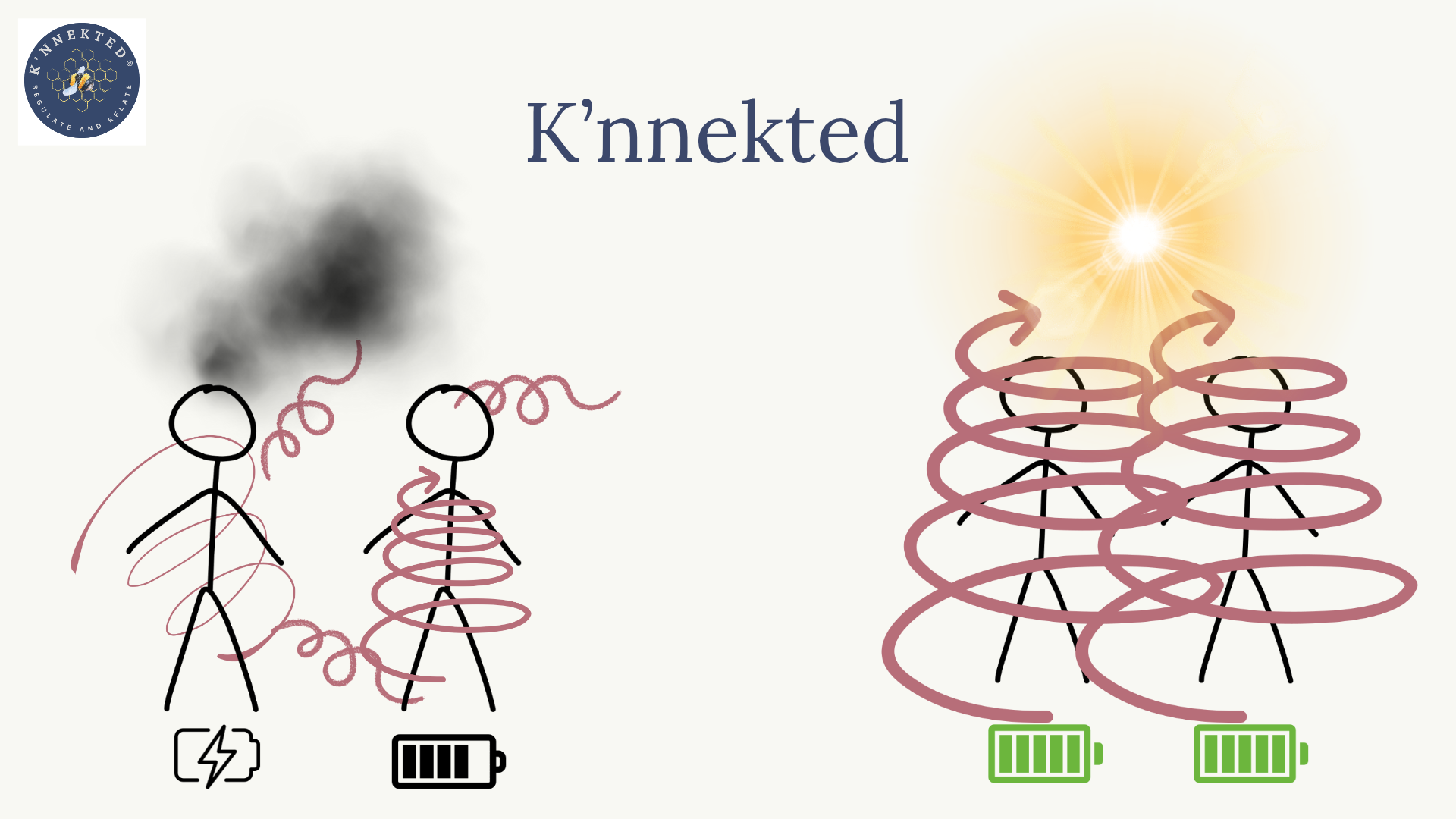
This is why I often think about whether we are acting as radiators or drains.
Are we bringing energy, possibility, warmth and connection into the spaces we occupy? Or are we constantly depleting ourselves and those around us?
This isn't about being positive all the time. We all experience difficult emotions, challenging periods and moments when we have very little to give. It's about recognising that how we look after ourselves matters.
Looking after yourself isn't selfish: It's transformational.
This is perhaps the most important part of the K'nnekted philosophy.
We spend so much time trying to meet everyone else's needs that we can lose connection with our own. We suppress emotions, override our instincts, adopt beliefs and expectations that may never have been ours in the first place, and become disconnected from what actually makes us feel alive.
Over time, these experiences can shape our responses, our behaviours and our relationships.
Psychology and neuroscience help us understand how emotional experiences, stress and learned patterns can influence our bodies and behaviour. Implicit memories, conditioned responses and physiological stress patterns can all influence how we respond to the present. The body can carry the imprint of experiences, even when we don't consciously remember or understand where a particular response originated.
This is why K'nnekted places such importance on reconnecting with the body, recognising what's happening internally and developing the awareness to respond differently.
Rather than continually pushing through, we start listening. Rather than suppressing emotions, we learn to acknowledge and process them. Rather than living according to outdated conditioning and beliefs, we start questioning whether they still serve us. Rather than constantly seeking external validation, we begin to reconnect with what feels true for us.
We create space for calm, connection, self-awareness and ultimately, greater alignment.
this is where the ripple reaches our children.
When we start looking after ourselves, recognising our needs and allowing ourselves to live a life that feels more authentic, something important happens: our children get to witness it.
They see adults who have interests, passions, boundaries and dreams; they see people who can experience difficult emotions without being defined by them; they see that it's okay to say no, to rest, to play, to make mistakes and to follow a path that feels right for them.
We’re not just telling them how to live: We're showing them.
This applies far beyond parenting.
Teachers influence the emotional environments in which children learn, leaders influence the cultures in which people work, colleagues influence the atmosphere of a team, friends, partners and family members all contribute to the emotional environments they share.
The ripple works in every direction.
The K'nnekted principle
We cannot always control the circumstances around us, but we can begin to understand and influence how we respond to them. By reconnecting with ourselves, meeting our own needs, developing emotional awareness and learning to regulate our nervous systems, we create the foundations for healthier relationships.
We give ourselves permission to live in a way that feels more aligned with who we really are; and when we do that, we give others permission to do the same.
The greatest gift we can give the people around us isn't to constantly do more for them. It's to become more connected to ourselves, so that what we bring into the world comes from a place of wholeness rather than depletion.
When we change the relationship we have with ourselves, we change the ripple we create around us.
That's where K'nnekted begins.
The science and research behind the ripple
1. Relationships and brain development
How responsive interactions between children and caregivers help build brain architecture.
2. Emotional contagion and social connection
Emotional Contagion – Hatfield, Cacioppo and Rapson
Research explaining how people can unconsciously mimic and adopt the emotional expressions and states of others.
3. Epigenetics and environmental influence
How environmental factors can influence the way genes are expressed without changing the underlying DNA sequence.
4. Neuroplasticity and the ability to change
How experiences shape brain development and how the brain remains capable of change.
5. Quantum physics and entanglement
Nobel Prize – Quantum Entanglement
An introduction to quantum entanglement and the fascinating science of connected quantum systems. This is not evidence that human emotions are quantum-entangled.