How do we thrive as humans?
Let’s start at the very beginning.
My own research and learning around child development mirrors Maslow’s Hierarchy of Needs very closely.
The foundation of Maslow’s pyramid is physiological needs: food, water, warmth and rest.
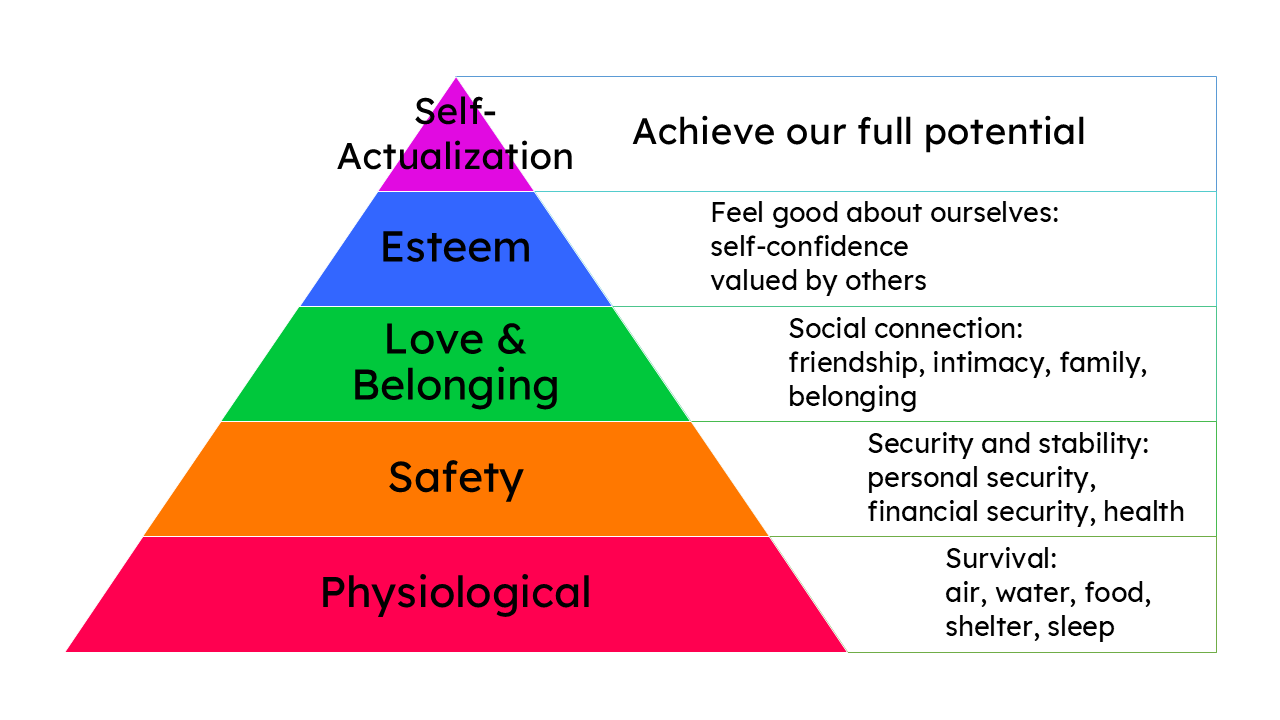
Image credit: Maslow’s Hierarchy of Needs Pyramid Graphic — Wikimedia Commons, CC0/Public Domain.
Interestingly, research into neuroscience and early childhood development suggests that our earliest experiences play a profound role in shaping how our nervous system develops and responds to the world.
The first years of life are a particularly sensitive period. Our brains and bodies are constantly taking in information from our environment: Am I safe? Am I cared for? Is there enough? Can I rest? Can I trust the people around me?
If we experience environments and caregivers who are rested, regulated, connected and have their own basic needs met, then it is more likely that our developing nervous system experiences the world as fundamentally safe.
We begin to learn, at a physiological level, that our needs can be met, and this is something we carry into adulthood.
Put simply, we learn that it is safe to relax. This makes it easier for children (and future adults) to explore, learn and play.
However, that leads me to the next question…
What if we experience the opposite of that?
Unpredictable environments and caregivers who are tired, dysregulated, disconnected and just about ‘getting by’ day by day. What if they are struggling to meet their own basic needs?
A child doesn’t have the capacity to understand why the adults around them are acting like they are. At that age, they can’t reason it ‘’My parents are stressed and tired because…’’
No, a child simply experiences the environment, and they learn, through experience, whether their needs are consistently met.
If the opposite is the case, their developing brain and nervous system develop and adapt differently. This can look like chronic stress, but it can also look like an incredible ability to adapt to the people and environments around them; becoming highly attuned to what is happening around them, sometimes referred to as hypervigilance.
In the early years, the nervous system simply does what it is supposed to do. It sets itself depending upon the people and environments it encounters; in essence it creates an internal map of how the world works.
It’s worth saying here, that all adults, parents, caregivers go through stressful times. This isn’t based on ‘one off’ experiences. Our brains and nervous systems are shaped through repetition.
What we experience repeatedly becomes information about how we need to act in the world to have our needs met at Maslow’s foundation level.
The thing is, unless we ever stop and bring awareness to our nervous system and our baseline wiring, we can go through the world carrying this pattern as if it is a completely normal part of us.
In fact, it may even be celebrated externally, as someone who is great at ‘reading the room’, being sensitive to everyone’s needs, being a great listener, and to be able to anticipate what will happen next.
The only problem comes when your system can’t switch these ‘skills’ off.
What we once learned to do to create a feeling of safety for ourselves, becomes the very thing that keeps our nervous system in a state of chronic stress.
Just because someone looks functional from the outside doesn’t mean that they’re fine inside.
What’s hidden inside, cannot stay hidden forever.
The body keeps the score (Bassel Van Der Kolk).
If the body is constantly experiencing the world as though it needs to be ready for what’s round the corner, then that is a ticking time bomb.
Eventually something has to give.
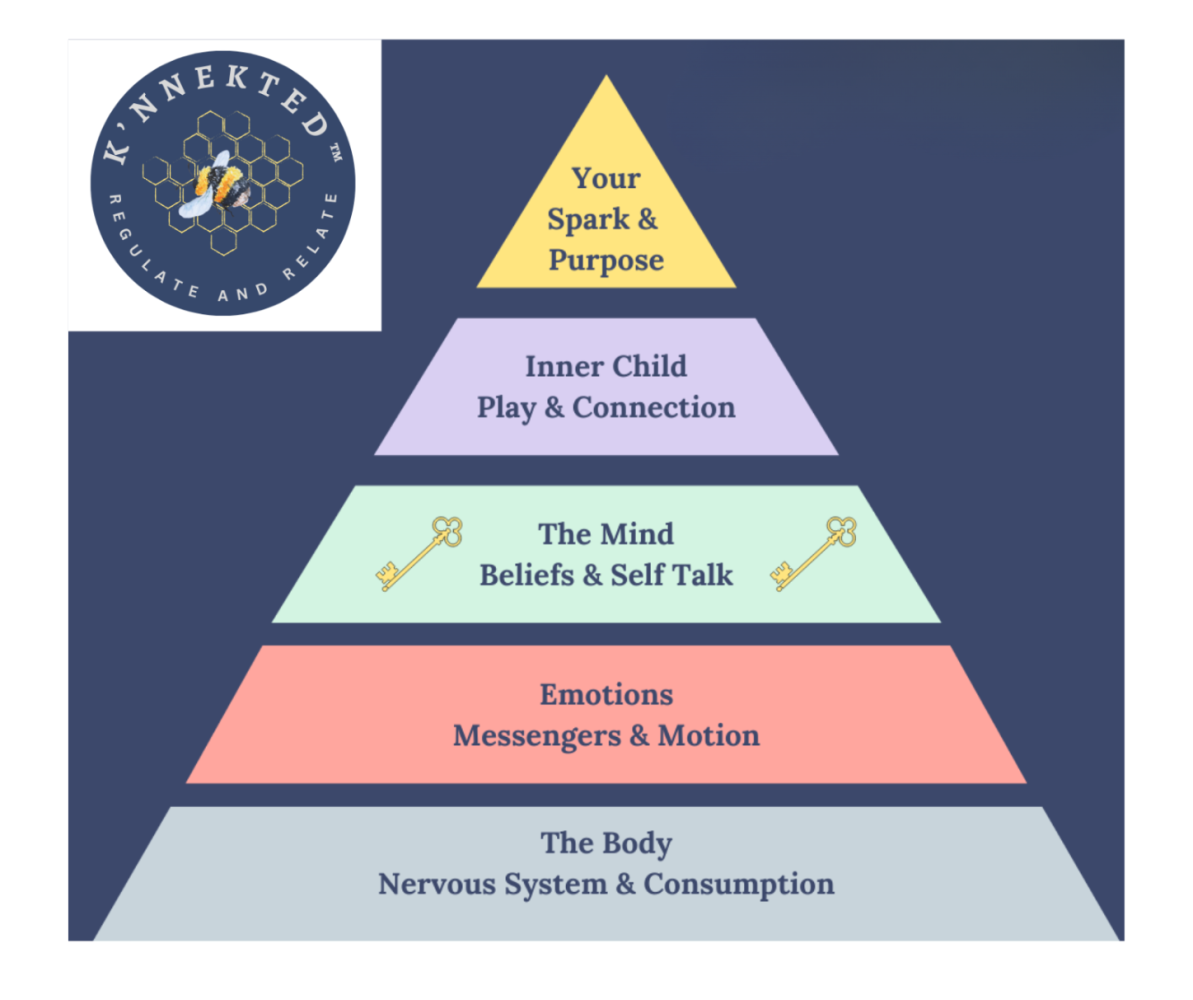
And having experienced that myself, this is where the K’nnekted Method was born. Step 1 is a complementary, inside out version of Maslow’s Hierarchy of Needs. The two sit side by side.
Maslow’s hierarchy looks at the external conditions we need to thrive.
K’nnekted starts with the internal conditions.
When we change what is happening within us, it creates a ripple effect. We are not isolated.
And that’s how we begin to change the pattern.