Following on from the last two posts in this series, today we’re looking at a vital part of being human….
Belonging.
You may remember that we explored Maslow’s Hierarchy of Needs in the first post.
On the third layer of his pyramid is Love and Belonging.
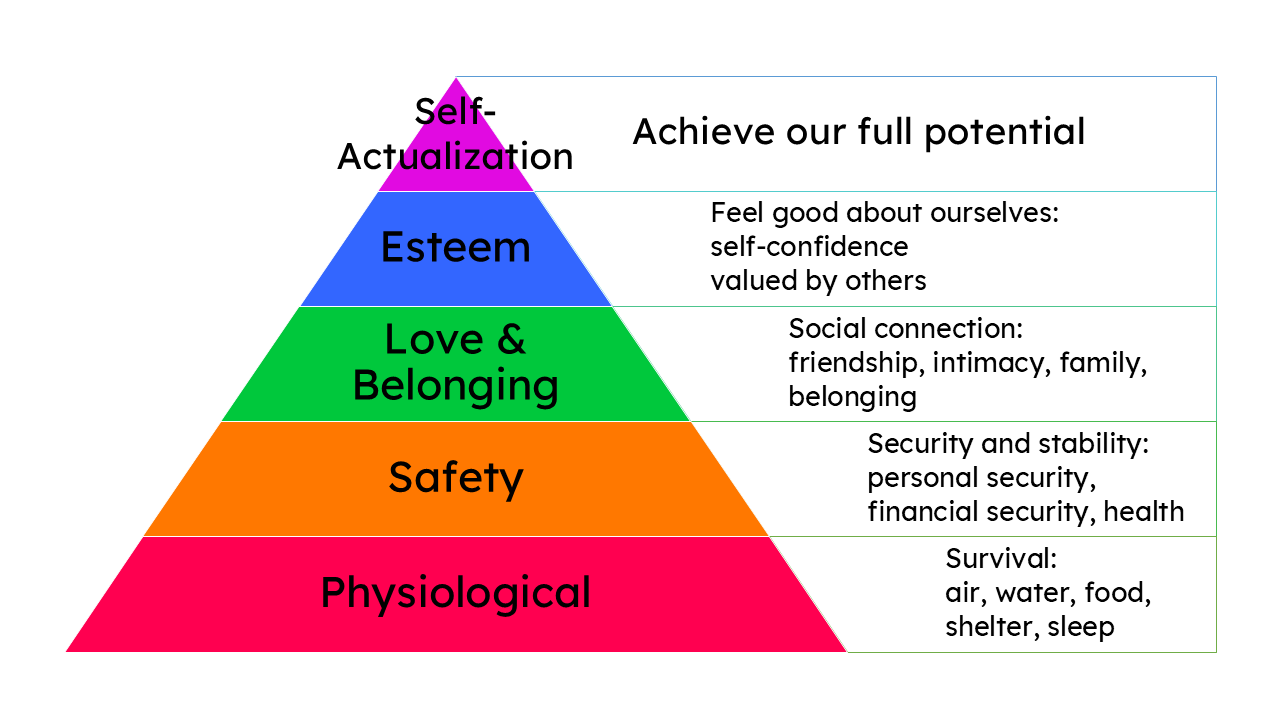
Image credit: Maslow’s Hierarchy of Needs Pyramid Graphic — Wikimedia Commons, CC0/Public Domain.
I think we can all agree that connection is fundamental to being human. So, if belonging is such an important need, why do so many people struggle with relationships? And how do we create a deeper sense of belonging in our lives?
That’s where I bring in the K’nnekted pyramid.
On the third layer is the mind, with the caption ‘beliefs and self-talk’.
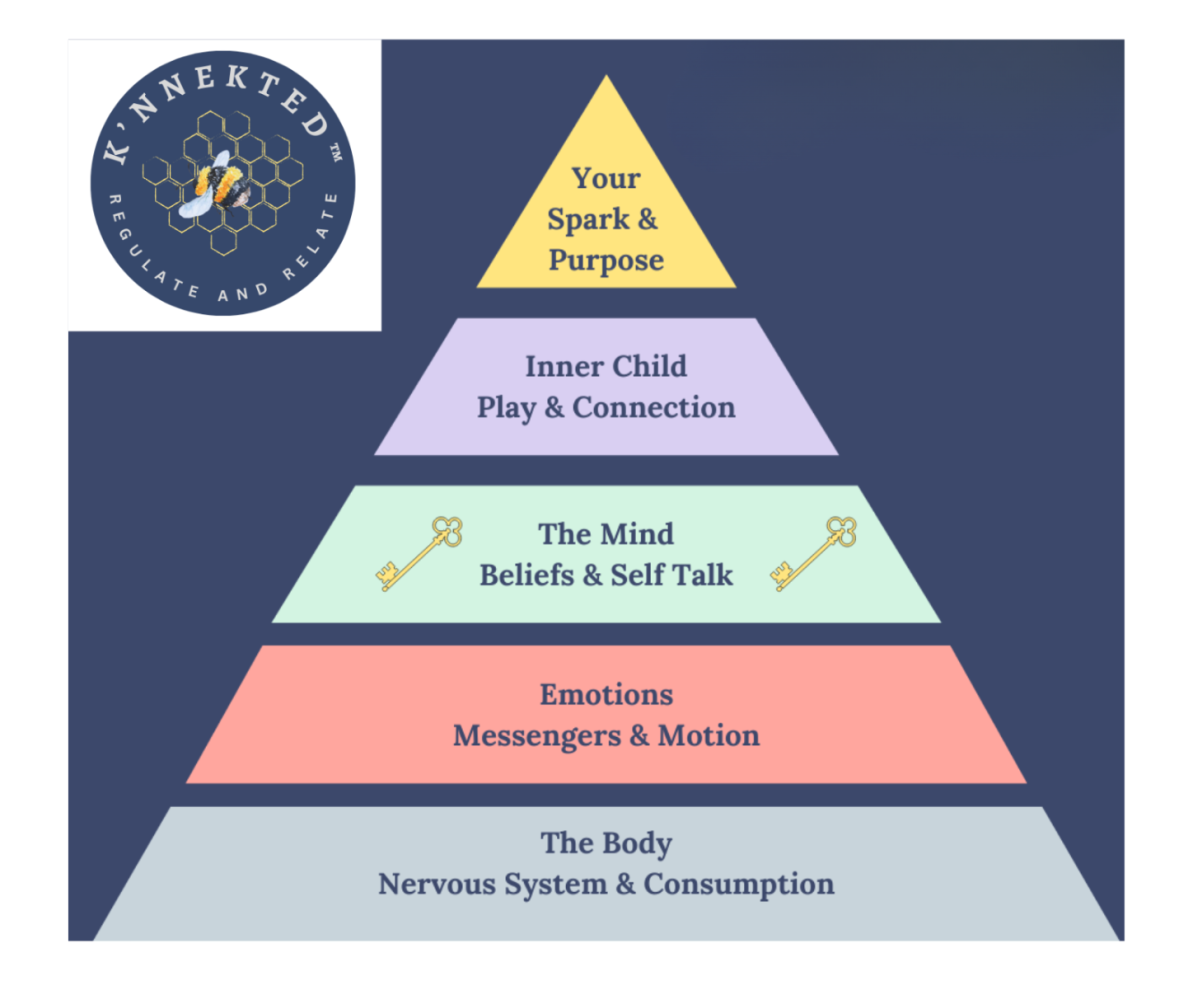
To allow love into our lives, we first need to believe that we deserve it. And I believe more people struggle with this than we realise.
Why?
Let me take you back to childhood and the developing brain.
Young children are naturally curious. They ask questions, explore the world and express themselves with far less awareness of the social rules that will eventually shape their behaviour.
Then we reach adolescence.
Adolescence is another significant period of brain development, when experiences and the environment can have a profound influence on how we see ourselves and relate to others.
“Like early childhood, adolescence is a period of heightened brain plasticity, when experiences and the environment can have a significant influence on development”
(Fuhrmann, Knoll & Blakemore, 2015, Trends in Cognitive Sciences)
During the teenage years, belonging can feel particularly important. We become more aware of how others see us, where we fit in and what we need to do to be accepted.
And this is where things can begin to change.
The questions and views we once expressed freely may suddenly be met with judgement. Our differences can become something to hide rather than something to embrace.
We might learn to silence our voice, keep our thoughts to ourselves and say what we believe others want to hear. We become people-pleasers because, somewhere along the way, we begin to associate belonging with being acceptable.
Or we go the other way; we make our voices heard loudly, push people away and reinforce the belief that we are different, that we don't fit in, or perhaps even that we're unlovable.
Either way, there is no winning scenario and we learn that belonging can come at a cost.
We learn to sacrifice parts of ourselves to be accepted, or we protect ourselves by deciding we don't need acceptance at all.
These patterns often begin as ways of protecting ourselves. Over time, they can become familiar ways of thinking and behaving, shaping our beliefs about who we are and what we can expect from other people.
Eventually, we stop recognising them as patterns and start believing they're simply who we are.
Is it any wonder that so many people struggle with self-doubt, including what we often call imposter syndrome?
But, all is not lost.
Neuroplasticity tells us that the brain can continue to change throughout life. With awareness, new experiences and practice, we can begin to question the beliefs and patterns we've carried for years.
On a personal level, having my own children has given me the opportunity to recognise patterns I've carried into adulthood. Children can be wonderful mirrors to our inner worlds!
My son is 15 and my daughter is on the edge of her teenage years. We are determined that they will enter adulthood as their truest selves. In parenting this way, it has meant walking alongside them, reparenting our own selves in the process.
It takes incredible strength and vulnerability to face the parts of ourselves we've carried for years and gently begin to put them down.
What I've found personally is that, as I've started to let go of my own protective patterns, I've felt my heart opening and reconnected with my sensitivity.
That has helped me understand why we put those defences up in the first place: we live in a judgemental world. There are expectations, projections and unwritten rules everywhere, alongside the people ready to give us a disapproving stare.
When you're a teenager, you're still developing the ability to regulate emotions, weigh up consequences and see situations from different perspectives. Judgement and rejection can feel particularly significant, and it's easy for negative self-talk to take hold.
As adults, we may have more experience and perspective. We can learn to recognise that someone else's judgement often reflects their own beliefs and experiences, rather than being a measure of our worth.
We don't have to take it on as our own.
So, if love and belonging are to become a fuller part of our lives, I believe we need to start by looking at the beliefs and protective patterns that tell us we aren't worthy of either.
Then we can begin by creating a world in which those defences don't need to develop so deeply in the first place.
What if we offered teenagers a little more love, curiosity and acceptance?
Their questions and views may challenge us, but that doesn't mean they're intended to offend. They're trying to make sense of the world around them, and sometimes they can see the flaws in the rules we've simply accepted.
When we create genuinely safe, non-judgemental spaces for them to speak, we can learn a LOT.
And when we encounter judgement in the adult world, we can remember that it often comes from beliefs and patterns learned long before that moment.
We don't have to meet judgement with more judgement. We can choose curiosity, compassion and we can stand in love without abandoning ourselves.
Real belonging isn't about learning how to fit in, it's about learning that we don't have to stop being ourselves to be loved.
If you’d like to follow my personal journey of reconnecting with love and dismantling the patterns I’ve carried for years, you can join me over on Substack here:
