Last time in our series of How to Be Human, we spoke about belonging, and the impact that our experiences, particularly during our teenage years, can have on our ability to love and be loved.
This time, we're moving onto step four of Maslow's Hierarchy of Needs…
Self-esteem and that dreaded word: confidence.
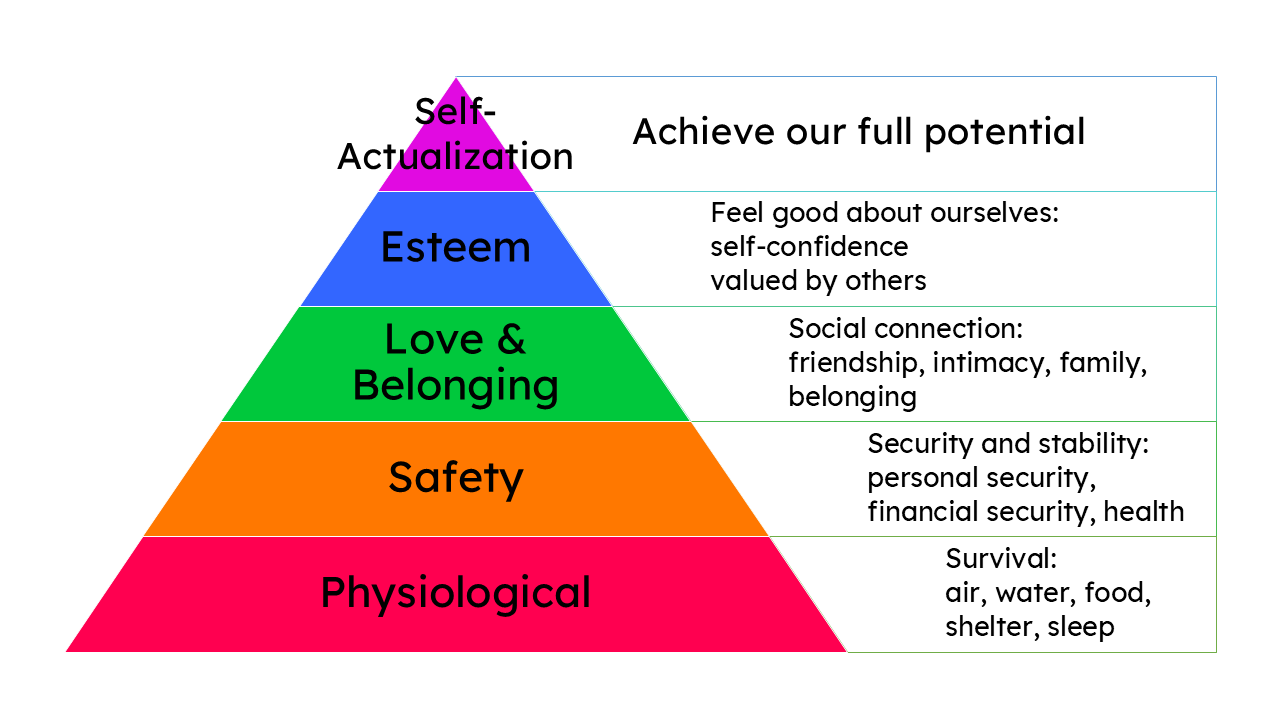
If we look at Maslow's hierarchy, esteem is about how we feel about ourselves, our self-confidence and our need to feel valued by others.
Somewhere along the way, we've created a society where being valued has become closely linked to what we achieve, what we know, the qualifications we hold and how successfully we perform.
Think about our schools and workplaces. We reward achievement, celebrate results and use qualifications and experience as measures of capability.
It's why we have the CV: to showcase our talents, demonstrate our experience and gain the respect of prospective employers.
And, of course, there's social media, where we can find ourselves measuring our worth in likes, comments and approval (Eurgh…)
There's nothing inherently wrong with recognition, achievement or learning new skills; they can be incredibly rewarding; but what happens when we start to believe that these things are what make us valuable?
What happens when we become so focused on proving our worth to others that we lose sight of the strengths and qualities we already possess?
And what if the confidence we've been taught to recognise isn't the whole picture?
What does confidence actually look like?
When I say the word confidence, I bet you can summon up a person. They're probably quite bold, socially expressive, not afraid to speak their mind and seemingly comfortable in almost any situation.
Perhaps they're the ones who put their hands up first, speak confidently in meetings and aren't afraid to make themselves heard.
We've become conditioned to recognise this as confidence.
However, there's another kind of confidence, one that sits quietly inside every single person.
It's the confidence that comes from knowing yourself; from recognising your natural strengths, trusting your instincts and feeling comfortable enough to express who you really are.
I think many of us have lose touch with it at different points in our lives.
When our strengths get mislabelled
I know this because I definitely did. I was a qualification hunter; I have certificates and achievements galore!
Whilst I enjoy learning, looking back, I can see that some of my deepest strengths weren't necessarily the things I was collecting qualifications for.
They lay in how I see things and how I express them, I am an observer; but when I was younger, I was labelled shy.
How many of us have spent years trying to correct something about ourselves that might actually have been one of our greatest strengths, simply because someone else didn't understand it?
How many children are being labelled before they've had the opportunity to discover who they are?
How many adults are still carrying those labels, shaping their behaviour around them without even realising it?
What matters is understanding ourselves well enough to recognise our strengths, how they show up and how we can use them in ways that feel good for us and the people around us.
This is where the K'nnekted pyramid comes in.
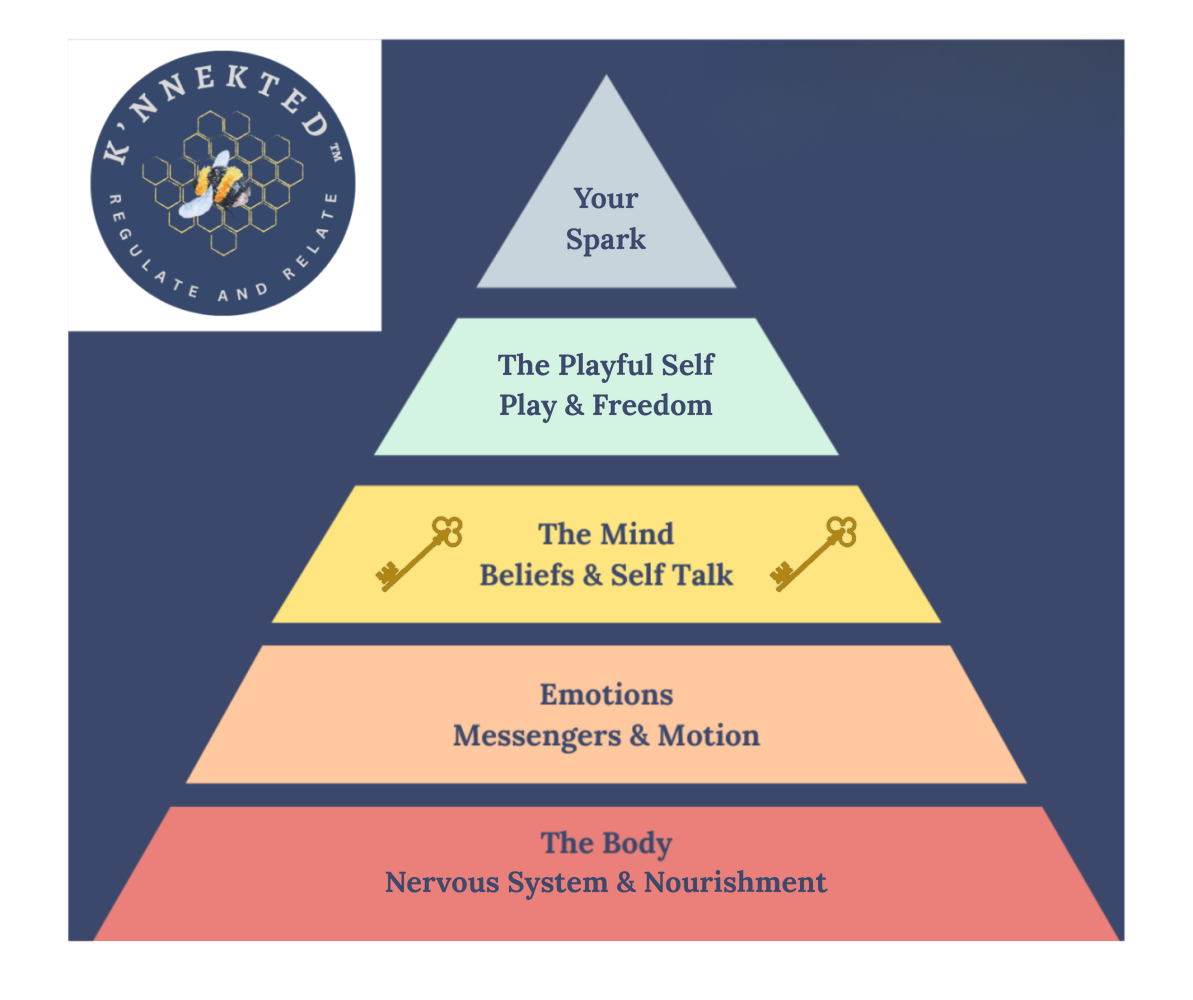
If we want to reconnect with our innate strengths, we need to look beyond what we've been taught to value and start paying attention to what genuinely brings us alive; which brings me to play.
Play: the way back to our innate strengths
Unfortunately, many of us have been conditioned out of play. Our education system often rewards intellect, achievement and the ability to produce the right answers. Workplaces reward targets, performance and measurable results.
Again, these things have their place, but they don't necessarily reveal the full picture of who we are.
Ask anyone who works in the Early Years, and they'll tell you how much we can discover about a child through play. I've spent a lot of time in Early Years throughout my career, and it's one of my favourite places to be.
It's where you get to see children being themselves. You see how they approach challenges, what captures their imagination, how they solve problems, how they interact with others and what happens when they become absorbed in something they love.
A few years ago, I wrote reports for children that their parents later told me they had kept and still read. I took the opportunity to shine a light on their innate gifts, even when those gifts didn't necessarily fit neatly within the expectations of the system. I wanted those children to be able to look back years later, read those words and remember who they were.
What if the education system was truly designed to help children recognise their innate strengths before the world gave them reasons to doubt them?
And what if we gave adults that same opportunity?
how do adults play?
For many adults, the word play feels a little abstract.
I've worked with clients and asked them how they play, only to be met with a blank expression. This seems particularly common among busy working parents, who spend so much of their time looking after everyone else that they've forgotten what they enjoy doing themselves.
Recently, I was talking to someone about my escapades in campanology. She told me she'd wanted to give it a go but was worried about making mistakes in front of other people or letting them down.
There it was: the mind, beliefs, self-talk. All the things that can stop us from doing something we're genuinely curious about.
We can become so concerned about how we'll be perceived that we never even give ourselves permission to try; but play isn't about being good at something. It isn't about performing, getting it right or proving our worth.
It's about exploration.
It's about giving ourselves permission to be curious, experiment, make mistakes and discover what we enjoy without needing to justify it.
Sometimes, in that process, we discover things about ourselves that we couldn't have uncovered by sitting down and thinking about them.
What happens when we play together?
One of my favourite parts of my work is the play workshop I've delivered with senior leadership teams.
It can take a little time for people to drop their masks and allow themselves simply to be present. After all, we're so used to operating within our professional roles. We're the manager, the leader, the problem-solver, the person who's supposed to know what they're doing.
Letting go of that, even briefly, can feel unfamiliar, but the effects can be incredible.
When we create space to play together, we begin to see different sides of one another.
Who naturally brings people together? Who spots the possibilities? Who experiments? Who thinks strategically? Who finds creative solutions? Who encourages others? Who thrives on a challenge?
We begin to see strengths that might not be visible in a meeting room or on a job description; and we begin to understand one another differently.
Imagine what could happen if workplaces made time for this kind of exploration regularly, then paid attention to what it revealed about their teams, their relationships and the way they work together.
Rather than assuming we already know what everyone brings, we could create opportunities to discover it.
When people understand their own strengths and appreciate those of others, they have a much better foundation for working together. A team becomes stronger when people can contribute in ways that draw on their natural strengths and complement one another.
That's a very different kind of confidence from simply being the person who speaks first.
Confidence isn't something we have to manufacture
What if the answer isn't to spend our lives trying to become more confident in the way the world tells us we should be?
What if, instead, we create the conditions for people to recognise and trust their own strengths?
There will always be another qualification to gain, another achievement to reach, another person to impress or another expectation to meet.
If we're constantly measuring ourselves against those things, we can end up working incredibly hard to become someone we think we should be, whilst becoming increasingly disconnected from who we actually are.
Some of the greatest inventions and discoveries have come from people experimenting, exploring and simply trying things out.
Sometimes, a change in life circumstances leads someone to take up a hobby they love, only to discover a new career in it.
That's not necessarily an accident.
When we give ourselves permission to explore what interests us, we can uncover strengths, possibilities and directions that might never have emerged through striving alone.
We don't have to abandon ambition, learning or achievement, we simply need to stop treating them as the only evidence of our worth.
We need to stop trying to manufacture confidence in people and start creating the conditions in which they can recognise and trust their own strengths.
So, where do we begin?
Perhaps we begin by asking ourselves a different question.
Instead of: What do I need to achieve to feel good enough?
Try: When do I feel most like myself?
What do I enjoy? What comes naturally to me? What am I curious about? What do other people come to me for? And what strengths might I have been taught to hide?
This is why play matters so much to me; it's not simply a break from the serious business of learning or working. It's an opportunity to reconnect with ourselves, recognise our innate strengths and see one another through a different lens.
Want to explore what this could look like in practice?
I work with schools, individuals and workplaces to help people reconnect with their strengths, challenge the beliefs that hold them back and create the conditions for people to thrive as themselves.
My play workshop has been designed to help teams step outside their usual roles, explore how they naturally think and work, and discover more about the strengths they bring individually and collectively.
I deliver workshops with teams, and the workshop can also be purchased for organisations who would like to bring the experience in-house and facilitate it themselves.
If you'd like to explore what this could look like for your school, team or organisation, or you're interested in discovering more about your own K'nnekted blueprint, I'd love to hear from you.
Confidence isn't about becoming someone new or trying harder; it's about rediscovering who you've been all along.
